

Single-Family vs. Multifamily Investment Properties for Beginners: Which Strategy Wins?
What’s the difference between buying a single-family home and a multifamily property as an investor? Learn the advantages and disadvantages of each. Find out how the financing is different. See an example, with actual numbers. Decide which approach works best for your goals.
When deciding between family and multifamily investment properties beginners need to be careful. This choice can affect the direction of the portfolio. Pick the kind of property for what you want and you might end up with low cash flow too much money tied up or management problems that cause stress. These issues can last for years. Make things harder than they should be.
I have seen how both asset classes build wealth. Asset classes serve financial goals. This guide breaks down how each asset class works, how the numbers compare and which asset class makes sense for your situation.
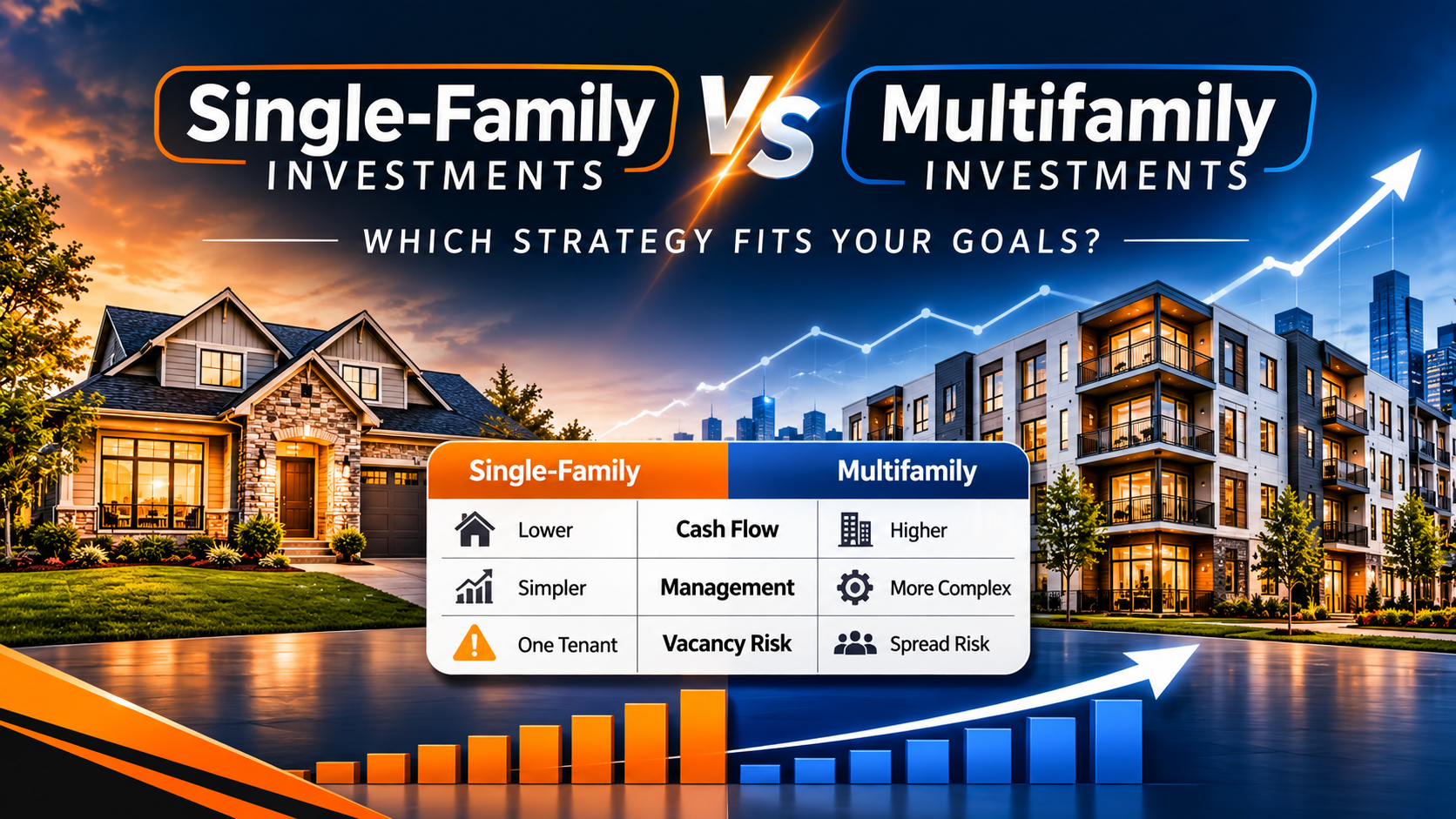
Understanding the Single-Family Home (SFH)
Single‑family home is a house built for one family. Single‑family home is the common type of residential property. For first timers single‑family home is the natural place to start investing.
Pros of Single-Family Investments
- Easier financing. Traditional loans, down payments and many lenders available make buying single-family homes simple.
- A bigger group of buyers. People who want to live in a home and people who buy for investment both purchase houses, which means there is lots of interest when you want to sell.
- Straightforward management. One roof, one agreement, one person to deal with as a tenant.
- Convenient selling. Selling a single-family home usually takes time and is not as hard, as selling a property with multiple units.
Cons of Single-Family Investments
- Thinner cash flow margins. Because one rent check covers the entire mortgage, monthly profit is often modest.
- All-or-nothing vacancy risk. When the tenant leaves, income drops to 0%.
- Limited scalability. Growing a portfolio means buying, financing, and managing house after house
Understanding the Multifamily Property (MFH)
A multifamily property is a building that has different living spaces all owned by the same person. Homes that have 2 to 4 units, like duplexes, triplexes and fourplexes usually get money from loans. Buildings that have 5 or more units are considered real estate and they are valued in a different way.
Pros of Multifamily Investments
- Economies of scale. One roof, one lot, and one set of systems serve multiple tenants, so cost per unit usually falls.
- Higher cash flow potential. Multiple rent checks cover the mortgage and leave a larger surplus.
- Built-in risk mitigation. If one unit is vacant, the others still produce income.
- Forced appreciation. In commercial-class properties especially, value is tied to net operating income, so raising rents or cutting expenses directly increases what the building is worth.
Cons of Multifamily Investments
- Harder financing. Larger loan amounts, stricter underwriting, and (for 5+ units) commercial loan terms add friction.
- More complex management. More tenants means more maintenance requests, turnover, and compliance requirements.
- A higher barrier to entry. The purchase price and reserve requirements are significantly larger.
The Financial Comparison
Cash Flow: Appreciation vs. Income
I see single-family homes tend to be appreciation plays. Their value is largely driven by sales and neighborhood demand and monthly cash flow is often a secondary benefit. I see multifamily properties tend to be cash flow plays. Rental income, from units is the main driver and the property is valued largely on what it earns.
Financing: Residential vs. Commercial Lending
A single-family home buyer and a small multifamily buyer who owns two to four units can usually get a home loan. These loans mostly depend on your credit score and your income. When the multifamily deals get bigger the type of loan changes to a lending loan. In lending the lenders look at the income the property generates, how well the property can cover its expenses and how experienced you are as a property manager. The loan terms are usually shorter. They often include a balloon payment, at the end. Require more money to be saved up.
Risk: Tenant Concentration vs. Management Risk
Single-family investors face tenant concentration risk, a risk that occurs when one tenant is the source of income. When that single tenant leaves, the income suddenly. The investor may lose a significant portion of return. Multifamily investors spread that risk by having tenants but they also face another risk: management risk. With units the investor must use stronger systems to keep operations running smoothly. If the operations are weak the returns can quickly. Erase the profits that the investor hoped to earn.
A Hypothetical Example: $300K Single-Family vs. $600K Duplex
This example is illustrative only. Your numbers will vary by market, rate, and property condition.
Single-family home priced at ($300,000)
- Down payment 20% plus closing costs: $66,000 put in
- Loan $240,000 at 6.5% over 30 years roughly $1,517/month
- Rent $2,300/month
- Taxes, insurance and reserves including vacancy and maintenance: approximately ~$560/month
- Monthly cash flow: approximately ~$223 (about $2,676/year)
- Cash-on-cash return ~4.1%
- Cap rate: ~7.0%
Duplex priced at ($600,000)
- Down payment (20%) closing costs: approximately ~$132,000 put in
- Loan $480,000 at 5% over 30 years, roughly $3,034/month
- Rent $2,700 per unit, $5,400/month total
- Taxes, insurance and reserves: ~$1,190/month
- Monthly cash flow: ~$1,176 (about $14,112/year)
- Cash-on-cash return ~$1,176 (about $14,112/year)
The duplex needs twice the money. Gives more than five times the yearly cash flow and a better return for the money spent. Course the single-family home would probably be easier to get a loan, for take care of and sell later.
Comparison Table: Single-Family vs. Multifamily
| Category | Single-Family (SFH) | Multifamily (MFH) |
| Initial Capital Required | Lower | Higher |
| Financing Difficulty | Easier (conventional loans) | Harder (commercial loans at 5+ units) |
| Cash Flow Potential | Modest | Stronger |
| Tenant Risk (Concentration) | High: one tenant | Lower: spread across units |
| Management Complexity | Simple | More complex |
| Scalability | Slower, property by property | Faster, more units per deal |
| Exit Strategy (Resale Value) | Broad buyer pool, easier to sell | Narrower pool, valued on income |
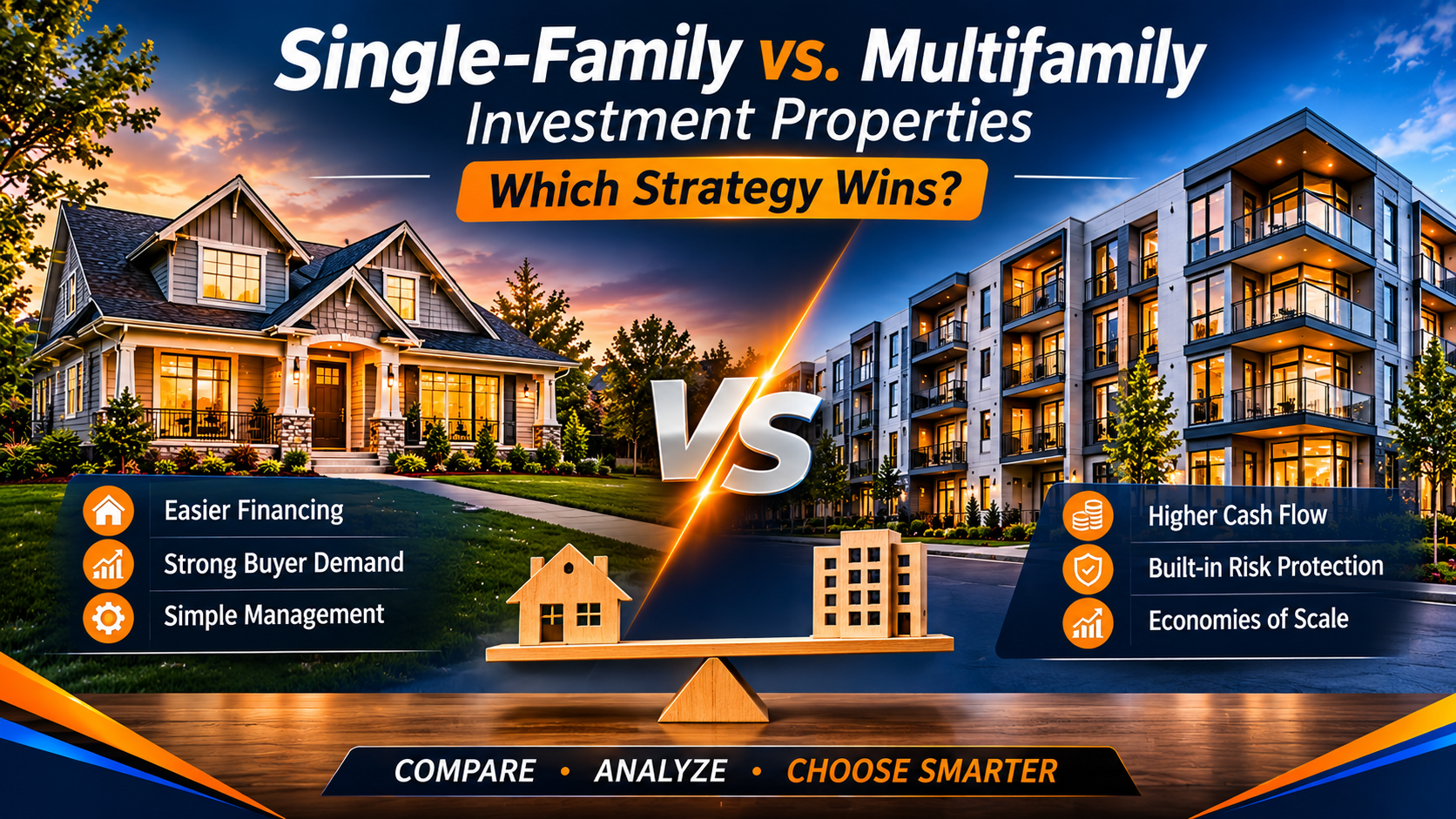
The Verdict: Which Makes Sense?
Than saying “it depends “ here are clear situations.
Choose a single-family home if:
- You prefer risk and a simpler process.
- You are eligible for loans with a smaller down payment.
- You care more about long-term value, than cash flow.
- You want a property that’s simple to sell if your plans change.
Choose multifamily if:
- You want to see cash flow
- You have capital or partners to buy a bigger property and keep reserves.
- You are comfortable doing active management or you are ready to hire a property manager.
- You want to grow with fewer deals to build a big portfolio.
Many beginners start with a 2-4 unit property. This type of property gives you financing and the cash flow benefits of a multifamily building.
FAQs
Which is better for a first-time investor?
Single-family rentals (SFRs) suit beginners who want simpler financing, lower upfront costs, and straightforward upkeep with one tenant.
Small multifamily properties (2–4 units) work well for beginners seeking stronger cash flow, “house hacking” potential, and income from multiple units at once.
How do vacancy risks compare?
Single-family: A single vacancy means 100% of rental income stops until a new tenant moves in.
Multifamily: One vacant unit rarely wipes out all income because remaining occupied units can continue generating rent.
How do financing and valuation differ?
Financing: Single-family homes and small multifamily buildings (up to 4 units) generally qualify for standard residential mortgages, while properties with 5 or more units typically require commercial financing.
Valuation: Single-family homes are usually priced based on comparable sales (“comps”) and appeal to owner-occupants as well as investors. Multifamily properties are heavily driven by Net Operating Income (NOI) and cap rates, meaning raising rents or cutting expenses directly impacts value.
What about maintenance, resale, and scaling?
Maintenance & management: Multifamily buildings involve more units, shared spaces, and potential tenant issues, requiring more time or professional property management.
Resale & liquidity: Single-family homes often sell faster because the buyer pool includes everyday homebuyers.
Scaling: Multifamily properties let you add multiple doors in one transaction, while many investors start with single-family homes and trade up over time.
How do utility bills and ongoing expenses compare?
Single-family: Tenants usually pay all utilities directly (water, electricity, gas, trash, and lawn care), keeping your monthly operating expenses predictable.
Multifamily: Older duplexes or triplexes often share water, sewer, or trash meters. If utilities aren’t separately metered, the landlord pays those bills and must factor them into the rent. You also cover common-area lighting and exterior maintenance.
How does tenant turnover affect costs and workload?
Single-family: Tenants tend to stay longer (often 2–3+ years) because families treat the house like a permanent home, resulting in lower turnover and make-ready costs.
Multifamily: Apartment or duplex tenants move more frequently (often every 12–18 months), leading to higher annual expenses for cleaning, painting, and leasing fees.
Which strategy builds wealth faster?
Single-family: Often leans more on long-term appreciation because prices track the broader retail housing market.
Multifamily: Typically prioritizes monthly cash flow and forced appreciation improving units to raise rents directly increases the property’s income potential.
What are the minimum down payment requirements?
Owner-occupied (“house hacking”): If you live in one unit of a 1-to-4-unit property for at least one year, FHA loans allow down payments as low as 3.5%, and conventional loans can go down to 3%–5%.
Pure investment properties: Buying without living on-site typically requires 15%–20% down for a single-family home and 20%–25% down for a 2–4 unit multifamily property.
Conclusion
Single-family homes give you simplicity. They are easier to finance. They also offer flexibility when it comes to selling. On the hand multifamily properties bring stronger cash flow. They have built-in protection, from vacancy because you have units. You can also scale faster with multifamily… These benefits come at a cost. Multifamily properties require capital. They are also more complex to manage. So, when choosing between family and multifamily investment properties there is no one-size-fits-all answer. The right answer depends on your capital. It also depends on your risk tolerance. It depends on your timeline.
Before you make a purchase do the math. Figure out your cash flow, cap rate and cash-on-cash return, for every property you look at. A deal only makes sense if the numbers add up.