The Future of Sustainable Luxury: 2026 Luxury Market Trends Redefining Value, Status and Style
A market analysis for brands, investors and discerning consumers
The future of luxury is being reshaped by 2026 luxury market trends, as consumers increasingly value sustainability, authenticity, craftsmanship, and meaningful experiences over traditional status symbols. Explore how evolving consumer expectations, responsible production, circular luxury, and experiential spending are redefining value and creating new opportunities for luxury brands and investors.
Every year’s experts say luxury has hit its peak. Every few years the industry shows them wrong again. Still just saying the sector keeps bouncing isn’t enough anymore. To really see what’s next, for luxury especially when it comes to 2026 luxury market trends we need to go beyond numbers and sales reports. We have to ask: what do people actually care about now? What makes them willing to pay more? The answer is shifting faster than many old-school brands want to accept.
Economic turbulence, shifting inflation and uneven consumer confidence have all tested the sector. The top end of the market has usually stayed stronger than the middle. Wealthy clients continue to buy during downturns and aspirational shoppers only reluctantly switch to lower options. The main change lies in the criteria used. Provenance, longevity, ethics and meaning now sit beside craftsmanship and brand heritage. This article looks at the forces, behind this shift. What they mean for the coming year.
The Macro Shift: A New Generation Redefines Value
The biggest transfer of wealth in history is happening right now. The people receiving this wealth aren’t just taking over their parents investments. They’re changing what it means to own a luxury item. millennial’s and Gen Z are already driving a growing portion of global luxury spending. As they start to inherit wealth their impact will only grow stronger. Any real look, at the future of luxury and the 2026 luxury market trends has to start with this shift. It’s not about money. It’s about values, identity and what people want to show when they buy something. This generation is redefining luxury. They’re not just buying the things. They’re buying differently.
From status symbol to statement of values
For generations a visible logo meant success. Now younger wealthy shoppers care more about who made the product, where it came from what it’s made of and what happens to it after they are done. Luxury is no longer, about showing off. It’s about who you’re what you stand for.
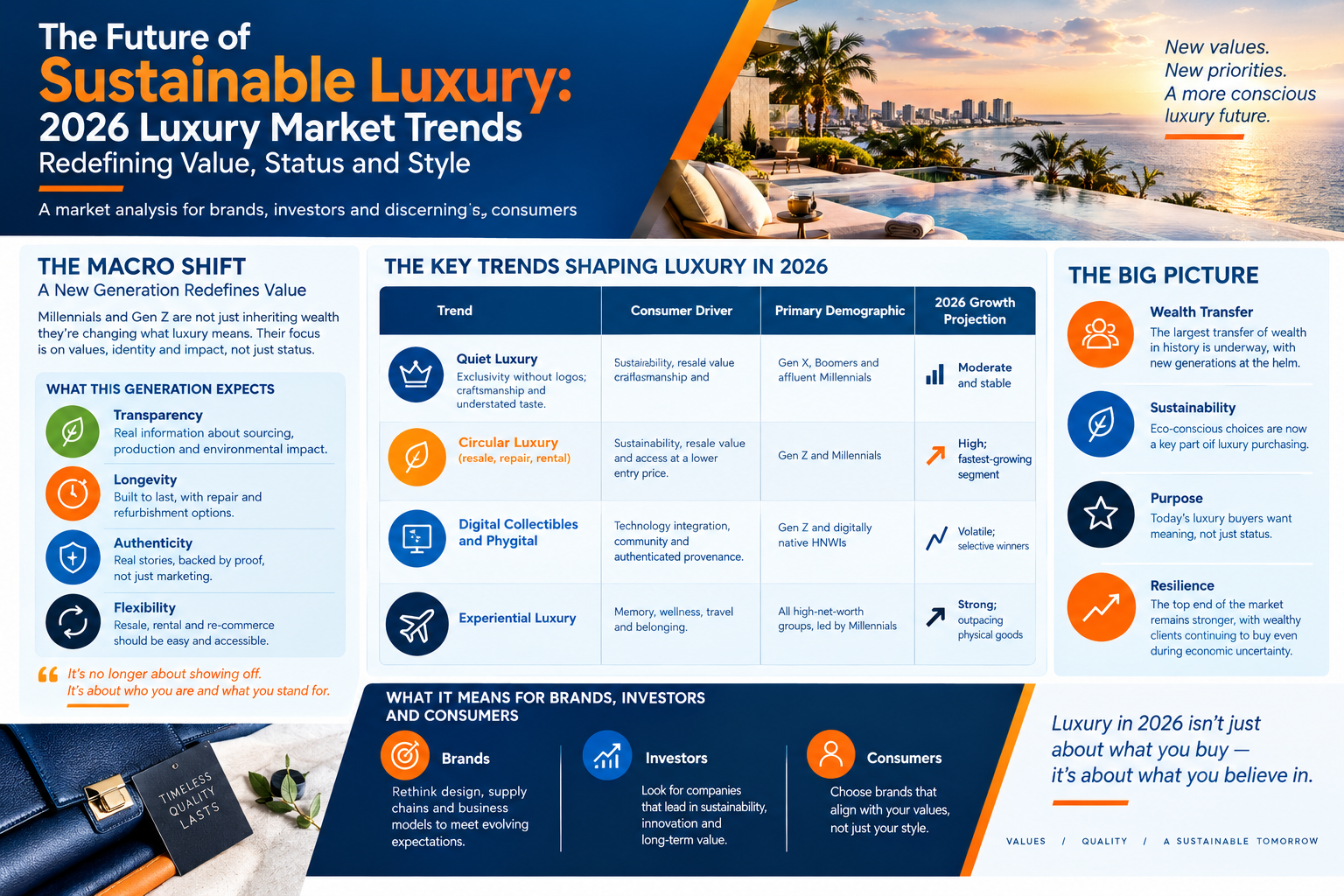
What this Generation Expects from a Luxury Brand
- Transparency means giving information about where products come from how they are made and how they affect the environment. People want to know the truth not just feel good about a story.
- Longevity is about making things that last. It’s not enough to build something. Brands must also offer repair services. Fixing a product of replacing it keeps it useful for longer.
- Authenticity is key. A brand story must be real. It should be supported by proof, not fancy words. When a brand says something, people need to see it in action.
- Flexibility means offering more than buying a product outright. Resale, rental and re-commerce should be easy. People don’t always want to own something. They want options.
Brands that think of these expectations as something to fix with messaging will fall behind. Those that see them as a challenge for product design and day-, to-day operations will earn trust. That kind of loyalty is stronger than anything advertising can buy.
The Data: Comparing the Trends Shaping the Market
Not every luxury trend carries the heavy load and not every luxury trend will deliver on the promise made early. I notice the table below compares four of the discussed movements by what drives movements, who is buying and where momentum appears to be heading in 2026. The growth projections are estimates that point, in a direction based on industry patterns not precise forecasts.
|
Trend |
Consumer Driver | Primary Demographic |
2026 Growth Projection |
|
Quiet Luxury |
Exclusivity without logos; craftsmanship and understated taste | Gen X, Boomers and affluent millennial’s |
Moderate and stable |
|
Circular Luxury (resale, repair, rental) |
Sustainability, resale value and access at a lower entry price | Gen Z and millennial’s |
High; the fastest-growing segment |
|
Digital Collectibles and Phygital |
Technology integration, community and authenticated provenance | Gen Z and digitally native HNWIs |
Volatile; selective winners |
|
Experiential Luxury |
Memory, wellness, travel and belonging | All high-net-worth groups, led by millennial’s |
Strong; outpacing physical goods |
Reading the Table
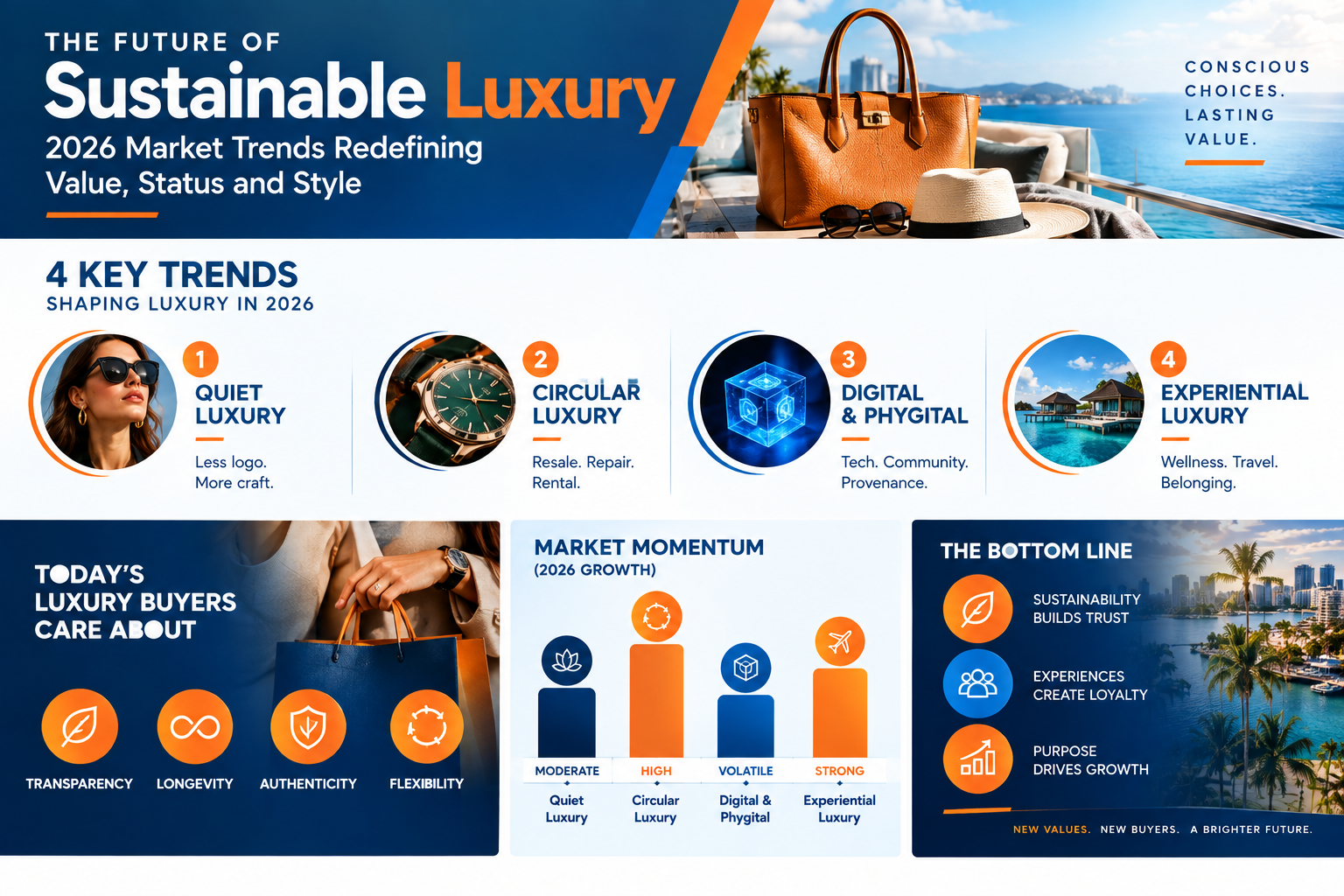
Quiet luxury has become more than a trend it has grown into a lasting style. Its development has been consistent but not fast. On the hand circular luxury is where big changes are happening. Resale websites, programs for used items and services to fix products are turning something that was once a problem for selling new items into a new way to make money. Digital collectibles are still the hardest to predict. The initial excitement has gone down. The idea of being able to prove that something is real and has a clear history is still finding useful ways to be used. In the future of luxury, the 2026 luxury market trends show that the trends focused on lasting quality and trust are staying longer, then the trends focused only on new things.
Sustainability as a Standard, Not a Selling Point
Quiet luxury has become more than a trend it has grown into a lasting style. Its development has been consistent but not fast. On the hand circular luxury is where big changes are happening. Resale websites, programs for used items and services to fix products are turning something that was once a problem for selling new items into a new way to make money. Digital collectibles are still the hardest to predict. The initial excitement has gone down. The idea of being able to prove that something is real and has a clear history is still finding useful ways to be used.
From Green washing to Proof
People, government officials and journalists are all better at recognizing environmental statements. Rules in markets especially in Europe are making companies move toward proof-based sharing of information and away from general words like “econ-friendly” or “green.” For high-end fashion brands, which depend on trust one problem with their reliability can cause long-term harm. The strongest brands are putting money into tracking so they can prove, not talk about, where their materials are, from.
The Practical Pillars of Sustainable Luxury
- Responsible materials: certified leather and fibers lab-grown and recycled alternatives and sourced gemstones and metals.
- Supply chain traceability: digital product passports and batch-level records that follow an item from material to retail.
- Circular models: repair, refurbishment, authenticated resale and take-back programs that keep products in use.
- Fair labor and artisan investment: protecting craft skills while ensuring workers are. Paid fairly.
- Lower-impact operations: energy, in ateliers and stores and reduced packaging waste.
Why This is Now a Survival Issue
Sustainability has gone from being about how a company’s seen to being about how a company operates. Scarcity of materials problems caused by climate change affecting farming supplies and stricter rules about sharing information all influence costs and how well a business can keep going. A brand that has a strong supply chain is just better off. That is why the future of luxury, in 2026 is best seen as something that every company must do: the companies that start building these skills early will create the standards that others have to follow.
The Tension Luxury Must Resolve
There is a puzzle here. Luxury has always been about wanting things and having few of them. Sustainability wants people to buy less and hold on to things longer. The industry’s solution is to make higher quality items and to stand behind them for many years. A made item that gets fixed and then sold again is probably the first example of something that’s good, for the planet.
The Experience Economy: Owning Moments, Not Just Things
A shift is happening that is changing how wealthy people spend their money. More and more they are choosing things like travel, fine dining, wellness retreats, private events and access to culture over buying goods. This change fits well with what experts expect for the luxury market in 2026. Experiences tend to use resources leave deeper emotional memories and can’t be easily copied or sold at a discount, like a handbag can.
Luxury Brands Become Hospitality Brands
Many fashion and jewelry houses are taking steps by opening cafes, restaurants, hotels and private member spaces. They are also holding exhibitions and workshops to draw people in. The flagship store is no longer a place to buy things it has become a destination on its own. For the client buying something is no longer a one-time event. It is now part of a journey, a chapter in an ongoing relationship, with the brand.
Where Experience and Sustainability Meet
- Craft immersion: workshops where clients get to meet the people who make the products and learn how each item is created.
- Regenerative travel: trips that help communities and protect the environment instead of taking from them.
- Wellness and slow luxury: time, privacy and space are the valuable things, in today’s world.
- Community access: memberships, early views and special events that reward people who stay with a brand for a time instead of just buying things quickly.
It is important to know that the experience economy does not take the place of products; it changes how people see them. The best brands use experiences to add meaning to the things they sell and they use sustainability to make that meaning real.
Risks and Open Questions for 2026
- A balanced view of the future of luxury in 2026 must recognize that the road ahead is not easy.
- Cost pressure: traceability, certified materials and repair infrastructure need a lot of money and smaller houses may find it hard to keep up.
- Measurement gaps: industry standards for impact reporting are not the same which makes it hard to compare brands.
- Consumer inconsistency: people say they care about sustainability. When prices go up they do not always act on those values.
- Counterfeiting and resale integrity: the growing secondary market needs ways to check if items are real.
- Currency swings: demand, in certain areas can change fast which affects even the biggest and strongest brands.
What Brands and Investors Should Do Now
· Check the supply chain. Share real detailed information instead of general statements.
· Take control of the secondhand market by starting resale and repair services before other companies take the customer.
· Invest in skill and lasting quality because lasting products are the sign of being good for the planet.
· Create experiences that take the brand further than the product and make customers feel more connected.
· Talk about values, with proof. Don’t promise too much about goals the company isn’t ready to achieve yet.
Conclusion: The Next Chapter of Luxury
The luxury market is not fading; it is maturing. The old way of doing things—relying on logos, fake scarcity and blind trust in status—is ending. Now people want brands that stand for something. They want trust. They want things that last. They want meaning. The future of luxury is clear. All signs point to 2026 showing a shift toward brands that can back up their claims support their products for life and create experiences that matter much as the products themselves.
In the years to come the difference between a product and a service will become harder to see. Digital product passports will be normal. Resale will no longer feel like a choice—it will be part of the brand’s own world right beside new items. The luxury houses that succeed will see the future of luxury: 2026 luxury market trends not, as a short-term trend or a marketing trick but as the real foundation of what luxury will be.