

How Long Should Your Home Stay on the Market Before You Consider a Price Reduction?
Selling a home is a journey. When offers don’t come in fast as you hoped doubt creeps in. You start to think: Is something wrong, with the house? Are buyers not interested? Could the neighborhood be the problem? In most cases the real reason is much simpler. And much easier to fix. Than you might believe. When you ask how long should your home stay on the market before you consider a price reduction the answer always comes down to one thing: price.
This blog post will guide you through the facts the feelings, the flags and the smart steps you need to take. You’ll learn how to sell your home and get the best price possible. Whether you have just listed your home. Are already watching days go by with no offers understanding how long should your home stay on the market before you consider a price reduction can help you make clear confident decisions
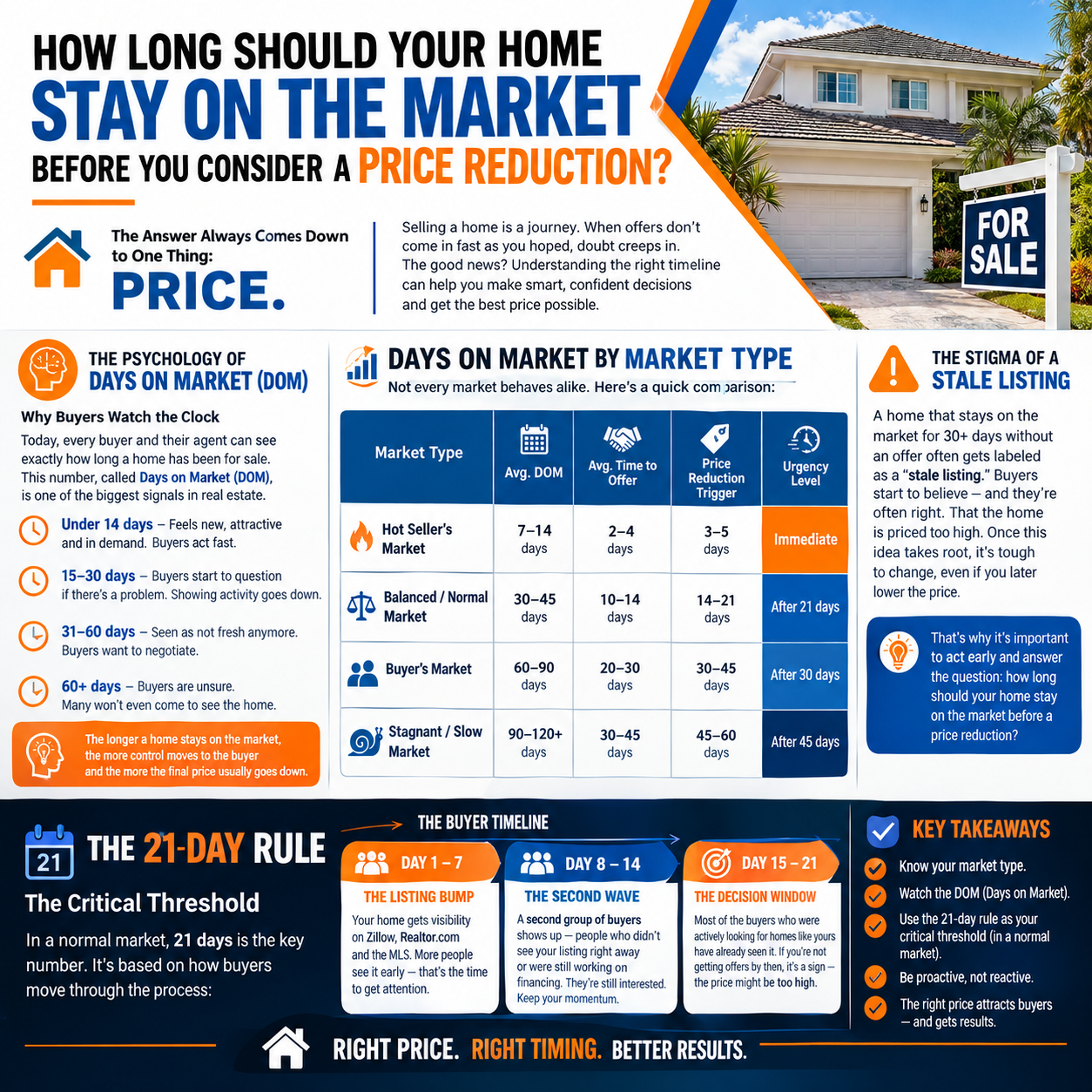
The Psychology of Days on Market (DOM)
Why Buyers Watch the Clock
Before getting into data it is important to know how buyers think. In today’s world every buyer and their agent can see exactly how long a home has been for sale. This number, called Days on Market (DOM) is one of the signals in real estate.
- Under 14 days: The home feels new, attractive and in demand. Buyers feel they need to act
- 15–30 days: Buyers start to question if there is a problem. Showing activity goes down.
- 31–60 Days: The home is seen as not fresh anymore. Buyers want to negotiate
- 60+ days: Buyers are unsure. Many will not even come to see the home.
This is why how long your home should stay on the market before you think about lowering the price is not a money question. It is a smart and mental one. The a home stays the more control moves, to the buyer and the more the final price usually goes down.
The Stigma of a Stale Listing
A home that stays on the market for, then 30 days without an offer often gets labeled by real estate professionals as a “stale listing.” Buyers start to believe. They are often right. That the home is priced too high. Once this idea takes root in the minds of buyers it becomes very hard to change even if the seller decides to lower the price. That’s why the question of how a home should stay on the market before a price reduction is needed must be answered early. It’s important to act when the time comes.
Average Days on Market by Market Type
To answer how long a home should remain on the market before the price is lowered a home must first grasp the market conditions in its area.
Not every market behaves alike.
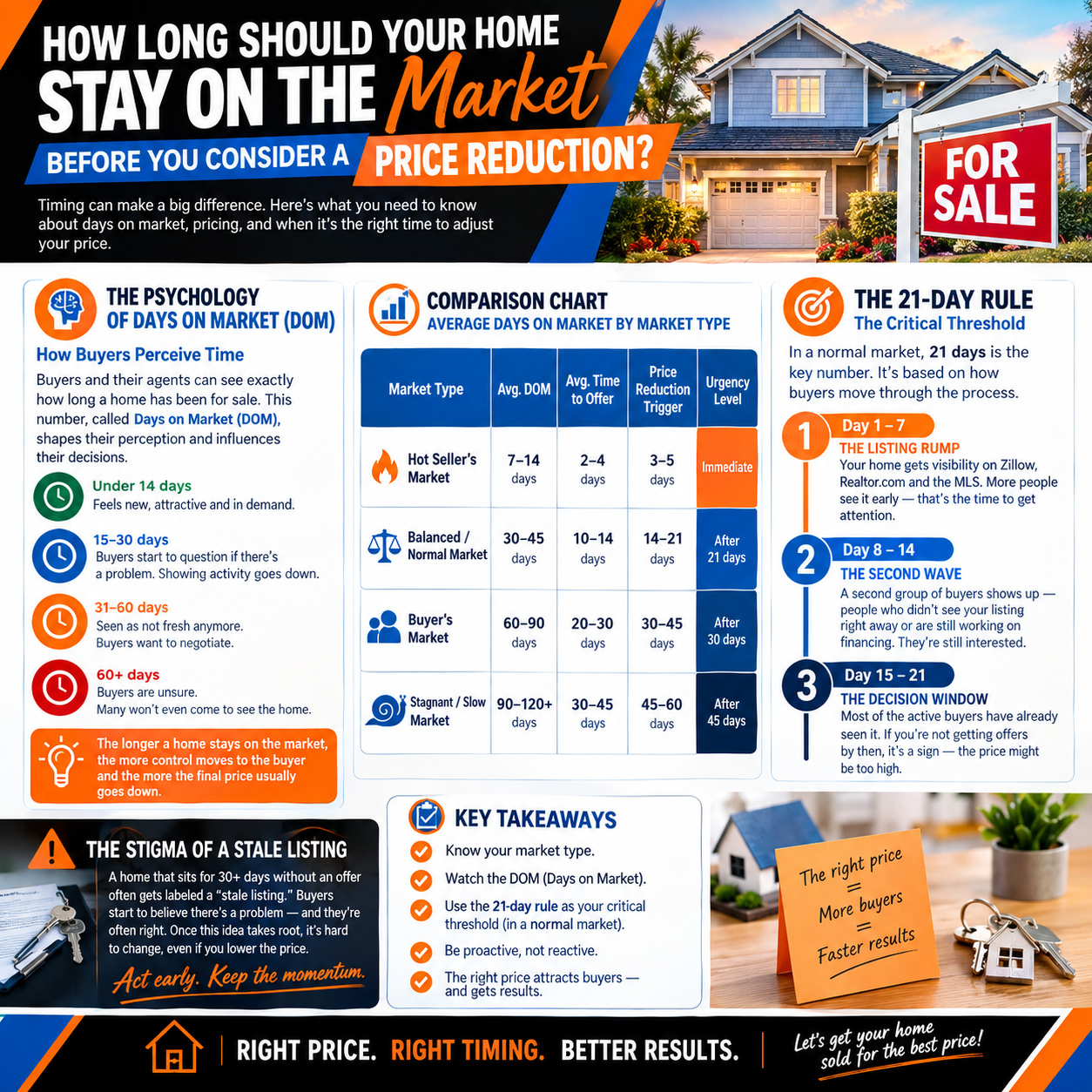
The table below displays days on market benchmarks, for various market types:
| Market Type | Avg. DOM | Avg. Time to Offer | Price Reduction Trigger |
Urgency Level |
|
Hot Seller’s Market |
7–14 days | 2–4 days | 3–5 days | Immediate |
| Balanced / Normal Market | 30–45 days | 10–14 days | 14–21 days |
After 21 days |
|
Buyer’s Market |
60–90 days | 20–30 days | 30–45 days | After 30 days |
|
Stagnant / Slow Market |
90–120+ days | 30–45 days | 45–60 days |
After 45 days |
The information is clear: in a fair market your home should not stay on the market for more, than 21 days before you think about lowering the price. That 21-day mark should be the point where you act. In a market that favors sellers that time frame is even shorter. In a market that favors buyers you might have a little time. But waiting too long is still risky.
Why 21 Days Is the Magic Number
Experienced real estate agents say that the question of how long should your home stay on the market before you consider a price reduction usually comes down to one key number in a normal market: 21 days. This number isn’t random. It’s based on how buyers move through the process. Here’s the thinking behind it:
• In the 1 to 7 days your home gets a boost. This is what people call the ” listing bump.” That means your property gets visibility on Zillow, Realtor.com and the MLS. More people see it early. That’s the time to get attention.
• Then from day 8 to day 14 a second group of buyers shows up. These are people who didn’t see your listing away or were still working on getting financing. They’re still interested. They’re not in a rush. That’s a window to keep your momentum.
• By day 15 to day 21 most of the buyers who were actively looking for homes like yours have already seen it. The market has already shown you who might be ready to buy. If you’re not getting offers by then it’s a sign. The price might be too high.
If you’ve had showings. People coming through asking questions taking notes. But no offers after 21 days the market is sending a message. It’s clear. The price is the issue. That’s when sellers need to step and ask the fundamental question: how long should your home stay on the market before you consider a price reduction? The answer, in cases is 21 days. After that it’s usually time to reevaluate.
What Counts as Heavy Traffic ?
Before deciding that a price change is necessarily make sure the home actually got chances to be seen:
• At least 8 to 12 showings in the first 21 days in a regular real estate market.
• least 15 to 20 online messages or saved listings on Zillow or Trulia.
• least 2 to 3 feedback forms from agents saying the home is priced too high.
If you have not met these numbers the problem might be with how the home’s being shown or advertised, not with the price. But if you have met these numbers and still have no offer you now know how long your home should stay on the market before you think about lowering the price: it should be at or, before the 21-day mark.
Overpricing Costs You More in the Long Run
Many sellers don’t want to lower their price. They think they can just wait for the buyer. The facts say something else. Research from the National Association of Realtors (NAR) shows clearly:
• Homes that are priced from the start sell for 98 to 102 percent of the asking price.
• Homes that have a price drop after 30 days sell for 94 to 96 percent of the price.
• Homes that stay on the market for 90 days or more and have several prices drops often sell for 87 to 92 percent of the asking price.
The truth is clear. The seller who does not ask the question. How should your home stay on the market before you think about lowering the price? Usually ends up with less money, than the seller who made a price change at the right time.
The Compounding Cost of Carrying
Beyond the sale price overpricing comes with carrying costs:
• Mortgage payments: Every extra month your home stays on the market means another mortgage payment you have to make.
• Property. HOA fees: These keep going up even if your home is not selling.
• Opportunity cost: The longer you wait, the later you get your money, which delays buying your home.
When you add all these carrying costs together the question of how your home should stay on the market before lowering the price becomes much more important. Waiting doesn’t come at no cost. It costs money every day.
Reading the Buyer Signals: Your Action Table
Not sure if it’s time to reduce? Use this quick-reference table to decode what the market is telling you:
|
Buyer Signal |
What It Means |
Recommended Action |
|
High Views, No Showings |
Price is too high for the perceived value | Reduce by 3–5% |
|
Showings, No Offers |
Home is competitive but slightly overpriced |
Reduce by 2–3% |
|
Offers Below Asking |
Market has set its price — time to meet it |
Reduce to match offers |
|
Zero Activity in 21 Days |
Listing has gone stale — urgent action needed |
Reduce by 5%+ |
| Too Pricey |
Multiple agents confirming the same concern |
Act immediately |
Price Reduction vs. Price Improvement: The Language of Strategy
re-framing the Conversation
At ET – OP Realty Group prefers to call a price reduction a “price improvement.” The distinction is more, than words. A price improvement is a data-backed move that brings your listing in line with what buyers have already told you the home is worth. A price improvement is not a failure. A price improvement is a correction.
How Much Should You Reduce?
When the time comes to improve your price the amount matters a lot.
• 2–3%: That’s a change for a home that’s already close to market value. It works well in competitive markets.
• 4–5%: That’s a shift. It brings back algorithm boosts on platforms and gets buyers to take a second look.
• 6–10%: That’s a move for a home that’s clearly priced too high. It shows buyers and agents that you’re serious about selling.
Anything than 2% usually doesn’t make a difference. Buyers and their agents are smart. A $2,000 drop, on a $400,000 home? That’s a blip. The point is to be confident. Make a move that matters.
Timing the Price Improvement for Maximum Impact
To maximize the impact of a price improvement:
• Make the change on a Tuesday or Wednesday. That way the listing is fresh for the weekend. Most buyers schedule showings over the weekend.
• Update the photos. Rewrite the description. This makes the listing look new and more attractive.
• Tell your agent to reach out to all agents who showed the home before. Let them know the price has changed.
• Share the listing, on media and in email campaigns. This brings in traffic. Keeps interest high.
How to Negotiate After a Price Reduction ?
Many sellers worry that lowering the price makes their home seem desirable.. That’s not always true. When done right a price drop paired with marketing can actually bring more buyers and create stronger negotiation power. Here’s how to handle negotiations after you’ve reduced the price:
• Set a response deadline: Have your agent let everyone know that all offers will be reviewed on a day. This builds urgency. Encourages faster decisions.
• Counter at or above the asking price: If buyers respond strongly after the price drop you can still push back and aim for a price close to your latest asking price.
• Use competing interest to your advantage: Even if you don’t have an offer making it seem like other buyers are interested can keep your current buyers honest and motivated.
• Avoid cutting the price too soon: If the first price drop brings activity wait 10 to 14 days before thinking about another reduction. Let the market respond.
In the end how you negotiate after a price drop depends a lot, on what’s happening in the market. That’s why having a good agent matters much. You want someone who knows when it’s time to lower the price. Not after the fact but before the question even comes up.
When does a house become “stale”?
Red flags: Usually appear after 3 to 4 weeks (21–30 days) of minimal activity.
Stale property: A home listed for more than 90 days is generally considered stale, often forcing sellers to accept lower offers (around 95.5% of the asking price).
When should you adjust your strategy?
Price or marketing review: Triggered after 30 to 45 days with few inquiries, or after 5 to 8 showings with zero offers.
Next steps: Lower the asking price, upgrade curb appeal, or temporarily pull the listing off the market during the winter holidays to relaunch in early spring.
What causes a home to sit too long?
Overpricing: Setting a price above market value or recent appraisals is the leading cause of delays.
Condition & design: Outdated kitchens, floor plan issues, or unaddressed structural/water damage.
Poor presentation: Lack of professional photography, staging, or flexible showing schedules.
Seasonality: Spring and summer see the fastest sales, while late-fall and winter (December–January) move much slower.
Does a price reduction make the seller look desperate?
It can if done poorly. To avoid this, refresh your listing photos, update the marketing description, or pair the price adjustment with improved staging or minor repairs.
Why isn’t my home selling after a month?
Overpricing is the number one cause of a delayed sale. Other common causes include poor listing photos, deferred maintenance, structural issues, or weak local buyer demand.
When should I drop the price?
Consider a price adjustment if you log 5 to 8 showings without a single offer, or if you reach the 4 to 6 week mark with very low interest.
How long should you live in a home before selling?
The general rule of thumb is 3 to 5 years to build enough equity and cover transaction costs like agent commissions and closing fees.
Should I offer buyer incentives instead of a price drop?
Offering a seller concession (like buying down the buyer’s interest rate or covering closing costs) is often cheaper than a massive price cut and highly attractive to today’s buyers.
Conclusion
How long should your home stay on the market before considering a price reduction? In a balanced market, around 21 days is a good benchmark, while a seller’s market may allow 10–14 days and a buyer’s market may warrant a pricing conversation by 30 days. If your home isn’t attracting the right activity, the market is giving you valuable feedback. A price reduction isn’t a defeat it’s a data-driven price improvement that can help you sell faster, reduce carrying costs, and maximize your final sale price. For the right strategy, work with a local expert who understands your property, neighborhood, and current market conditions. Alan Siegel and ET-OP Realty Group are here to help.