

How Florida Property Taxes Work for New Homeowners After Purchase: A 2026 Guide to Exemptions, Millage, and the “Reset” That Changes Everything
You closed on your Florida home, you looked at the seller’s tax bill, and you budgeted accordingly. Then your first full-year bill arrives and it’s far higher than you expected. This is the most common surprise in Florida real estate, and it’s predictable. This guide explains how Florida property taxes work for new homeowners after purchase, so you can budget accurately and claim every exemption you deserve.
Three levers decide how much you will pay: the valuation reset that happens when you sell the homestead exemption that you have to apply for yourself and the millage rate, for the place where your home is located.
The “Reset” Explained: Why Your Tax Bill Is Not the Seller’s Tax Bill
Florida property taxes for new homeowners, depend on the assessed value of the property. This assessed value is not always the same, as the market value. When a property is sold the county property appraiser updates the value to the market value. This update happens on January 1 of the year that comes after the sale.
That matters because long-time Florida owners often pay taxes on a value far below what their home is worth. The Save Our Homes (SOH) cap limits how fast a homesteaded property’s assessed value can rise, and that protection belongs to the owner, not the house. It does not transfer to you.
A Real-World Example
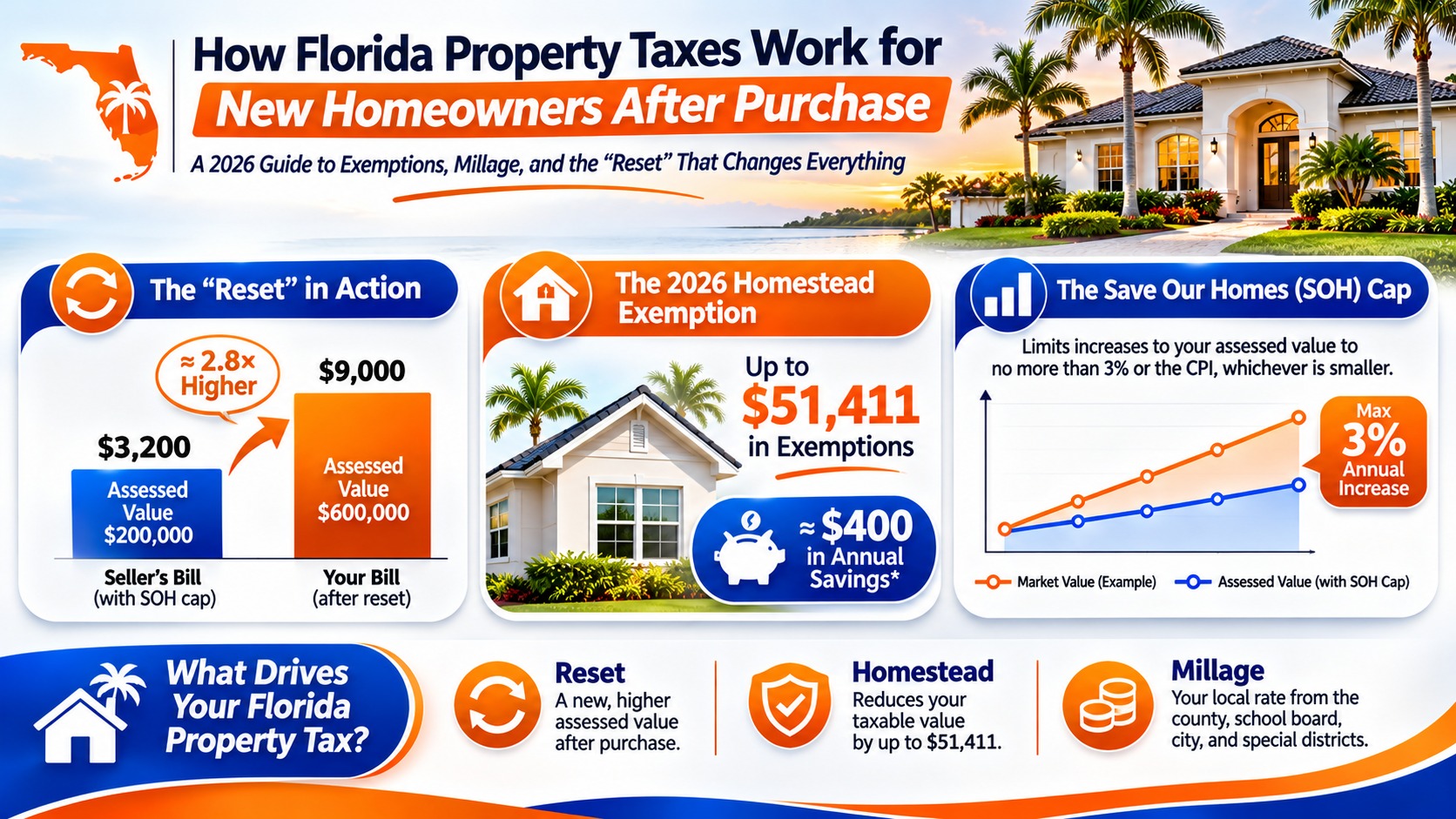
Suppose the seller’s home has an assessed value of $200,000 after 20 years of capped increases, but it sells for $600,000. After the reset, the appraiser assesses it near $600,000. At a combined rate of about 16 mills, the seller’s bill was roughly $3,200 before exemptions. Yours could approach $9,000 before exemptions, nearly triple.
Timing note: If you buy in 2026, your November 2026 bill is typically still based on the prior owner’s assessment, and the reset shows up on the following year’s bill. Many buyers get a false sense of security from that first low bill. Budget for the reset from day one.
The Homestead Exemption: Your Most Valuable Tool
If the home is your residence the homestead exemption is the single biggest tax reduction available to you. I know that understanding the homestead exemption is central, to understanding Florida property taxes for homeowners especially when your home is a permanent residence.
Eligibility
- The property must be. Lived in as a permanent residence, on January 1 of the tax year.
- The application must be filed by March 1 of that year.
- Florida residency must be established according to the timeline listed below.
The 2026 Homestead Exemption Structure
| Exemption Tier | Amount (2026) | Applies To |
| First exemption | $25,000 | All property taxes, including school district taxes |
| Second exemption | Up to $26,411 | Assessed value between $50,000 and $75,000; excludes school district taxes |
| Total maximum | Up to $51,411 | Combined, for homes assessed at $75,000 or more |
What It’s Worth
On a home that is assessed at $300,000 the exemptions lower the value to about $250,000. In Florida the average effective rate is 0.80%. That results in about $400, in annual savings. In high-millage counties the savings can be even higher. I find these numbers helpful when planning my budget.
The Critical Warning
The exemption does not transfer from the seller. You need to submit your application. If you sell in 2026 and move into the house as your home on January 1 2027 you must apply by March 1 2027 and the exemption will start for the 2027 tax year. Exceptions, for filing are very limited so consider March 1 as a strict deadline.
The Save Our Homes Cap: Long-Term Protection That Compounds
Once your home is set up the SOH cap begins to help you. Starting in the year of having your home the value of your home can go up by no more than 3 percent or the change, in the Consumer Price Index whichever is smaller.
The benefit compounds. In a rising market, the gap between your home’s market value and its assessed value can grow substantially over 10 to 20 years, shielding you from sudden market surges. It’s the same mechanism that created the “reset” shock for you, now working in your favor.
The cap only limits your assessed value, not your whole bill. Millage rates and non-ad valorem charges can still change, so expect some year-to-year movement.
Millage Rates: Why Location Within Florida Matters So Much
A mill is one dollar of tax for every one thousand dollars of value. Your total millage rate includes taxes from the county, the school board, the city and special districts. The formula is:
Taxable Value × Combined Millage Rate ÷ 1,000 = Your Property Tax Bill
Many homes also have -ad valorem assessments in addition to this. These can include fire service, solid waste, stormwater or Community Development District bond payments. These are common, in subdivisions and do not decrease because of your homestead exemption.
How Much Millage Varies
The total millage in all 67 counties in Florida usually goes from around 8.82 mills in Monroe County to 22.85 mills in St. Lucie County. The average for the state is about 15.82 mills. On a home that’s worth $350,000 and is homesteaded the first year’s bill is about $4,900 each year.
That is $408 every month. The county has an effect. Broward County has around 19.84 mills. That is much higher than Bay County with about 12.28 mills. Before you decide that you really like a neighborhood check the millage for that exact address. The rates can be different between cities, in the same county.
The First-Year Timeline and Common Mistakes to Avoid
Your First-Year Timeline
- At and after closing: Establish Florida residency by getting a Florida driver’s license, registering to vote, and filing a declaration of domicile if applicable.
- January 1: You must be occupying the home as your primary residence to qualify for that tax year.
- March 1: This is the deadline to file your homestead application with the county property appraiser.
- November: Tax bills are mailed. Pay early to capture discounts (typically 4% in November, declining monthly through March).
Mistakes New Homeowners Make
- Using the seller’s bill as an estimate. It reflects the old assessment and the seller’s exemptions, not your situation.
- Missing the March 1 deadline. Missing it usually means paying the full non-homestead amount for the year.
- Forgetting the school tax limit. The second exemption tier does not reduce school district taxes, so your savings may be smaller than a simple “$50,000 off” calculation suggests.
- Ignoring portability. If you’re moving from another Florida homestead, you may be able to transfer some of your accumulated SOH savings to the new home, but you must file within the required window.
FAQs
Why is my first tax bill different from what the previous owner paid?
Florida law requires the county property appraiser to remove previous exemptions and reassess the property to its full market (“just”) value upon a change of ownership.
The seller’s exemptions and Save Our Homes (SOH) assessment cap stay with the property for the rest of the calendar year in which you buy it. Your first tax bill may still reflect the seller’s status if you purchased before those taxes were paid, but the full reassessment takes effect the following January 1
How is my property tax calculated after the reset?
Your annual tax bill is calculated using this formula:
Tax Bill = (Assessed Value – Exemptions) × Millage Rate.
Millage rates are set by local taxing authorities (counties, cities, and school boards), and effective tax rates typically range between 1.0% and 1.3% of the property’s assessed value
How do I lower my property tax with the Homestead Exemption?
If the home is your permanent primary residence, you can apply for the Florida Homestead Exemption, which can reduce your property’s taxable assessed value by up to $50,000 (note: following the passage of Amendment 3 in November 2026, non-school homestead exemptions are scheduled to increase to $150,000 in 2027 and $250,000 in 2028 for qualifying permanent residents).
You can check with your local office or submit documentation via portals like the Pinellas County Property Appraiser or your respective county appraiser site
What is “Save Our Homes” (SOH) and Portability?
Once you have a homestead exemption, the Save Our Homes amendment caps annual increases in your home’s assessed value to 3% or the consumer price index (whichever is lower).
If you are moving from another Florida homesteaded property, you may be able to transfer (or “port”) up to $500,000 of your accumulated SOH benefit to your new home using Form DR-501T.
When do property tax bills get sent and due?
Florida property taxes are paid in arrears. County proposed-tax notices (TRIM notices) are mailed in August, and the official tax bills are sent out in late October or November.
Early payment discounts apply if paid early: 4% in November, 3% in December, 2% in January, and 1% in February, with the full balance due by March 31.
What is a CDD fee on my tax bill?
Many newer Florida communities are located in a Community Development District (CDD), which charges an annual non-ad valorem assessment on your tax bill to pay for neighborhood infrastructure and amenities. Unlike standard property taxes, CDD fees are not lowered by the Homestead Exemption.
Can I challenge my property’s new assessed value?
Yes, if you believe the county valued your home higher than its actual market value on January 1, you can contact the property appraiser’s office for an informal review. If you still disagree, you can file a formal petition with the county’s Value Adjustment Board (VAB) within 25 days of receiving your August TRIM notice.
Are there extra property tax exemptions besides Homestead?
Florida offers additional exemptions that can be stacked with your Homestead Exemption for qualifying residents. Common options include exemptions for seniors (65 and older) with limited income, military veterans with service-connected disabilities, widows or widowers, and individuals who are legally blind or permanently disabled.
Conclusion
The reset is real. It does not have to be painful. Learning how Florida property taxes work for homeowners after buying a home lets you plan for the cost of owning a home. Use the appraisers homestead page to see how the reset will affect homestead taxes.