
The Economic Impact of Global Wealth Migration: How the Migration of Wealth Is Reshaping Economies
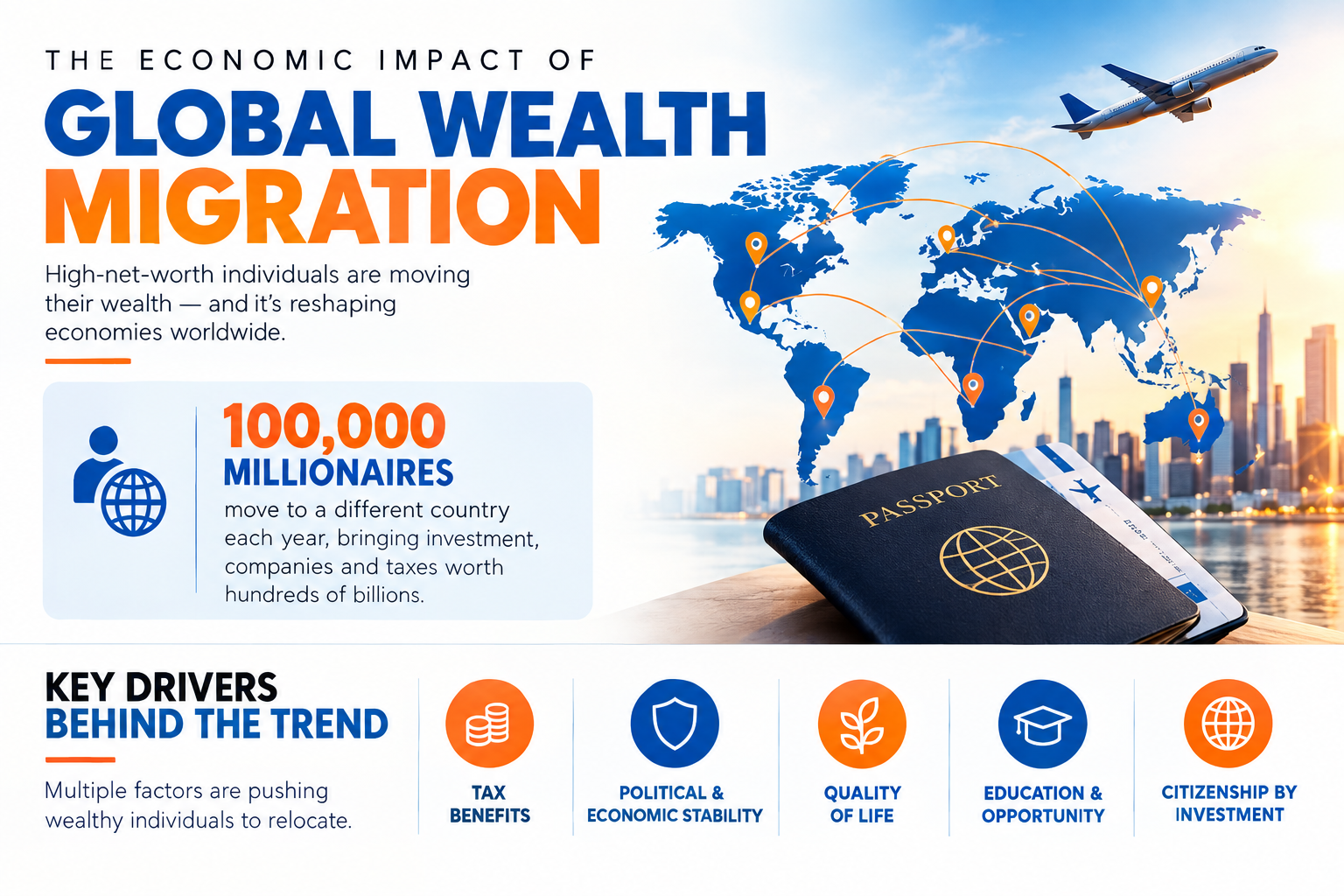
The economic effect of people moving their wealth around the world is one of the important and also one of the least known things that are changing the way the world’s economy works today. Every year tens of thousands of people who have a lot of money leave their homes take their families and move their money to countries. New numbers from Henley & Partners show that, then 100,000 millionaires move to a different country every year bringing with them investments, companies and taxes that are worth hundreds of billions of dollars.
This movement of money and people is more than a way of living. The shift of wealth changes the picture: it makes home prices go up in some cities takes away money from taxes in others and brings up important questions, about fairness, how well places compete and how unequal the economy is. In this article we look at what causes the movement of wealth, where the money is going and what the effects of moving money around the world mean for governments, companies and regular people.
What Is Wealth Migration?
Wealth migration, sometimes called millionaire migration, refers to the relocation of high-net-worth individuals and their assets from one country to another. It typically involves people with at least US$1 million in investable assets, though the economic effects are driven mostly by the ultra-wealthy, whose capital and influence are far larger.
Unlike migration migration of wealth moves capital as well, as people. I notice that a single entrepreneur who relocates can shift a company headquarters, a property portfolio and a family office in one move. That is why the economic impact of wealth migration is felt so quickly in housing markets, tax receipts and local business ecosystems.
Key Drivers Behind Wealth Migration Trends
There is no one thing that explains why money is moving around. Instead many different things come together. They often make each other stronger.
- Taxation: Wealth taxes, high income tax rates and inheritance taxes encourage high-net-worth individuals to move to places with lower taxes and traditional tax havens. Conditions that are good for income and capital gains are very attractive.
- Political and economic stability: confusion, changes in money values and worry about rules, on money movement cause people to take their money out of unstable countries and put it into more stable ones.
- . Quality of life: I notice that personal safety, clean air, good healthcare and a stable climate are now factors when wealthy families choose where to live. Remote work has made it easier to move from one fixed location so people are more open to relocating for living conditions.
- Education and opportunity: I see that families look at the distance to top‑tier universities and international schools and this plays a role in where families decide to settle. The education system in a country shapes a child’s future so it matters a lot.
- Citizenship by investment: I notice that countries like Portugal, Malta and several Caribbean nations offer citizenship or residency programs. These programs let investors gain mobility by buying property or making investments and citizenship by investment is a way to gain options, for travel and living abroad.
Where Is the Money Going? Top Destinations and Sources
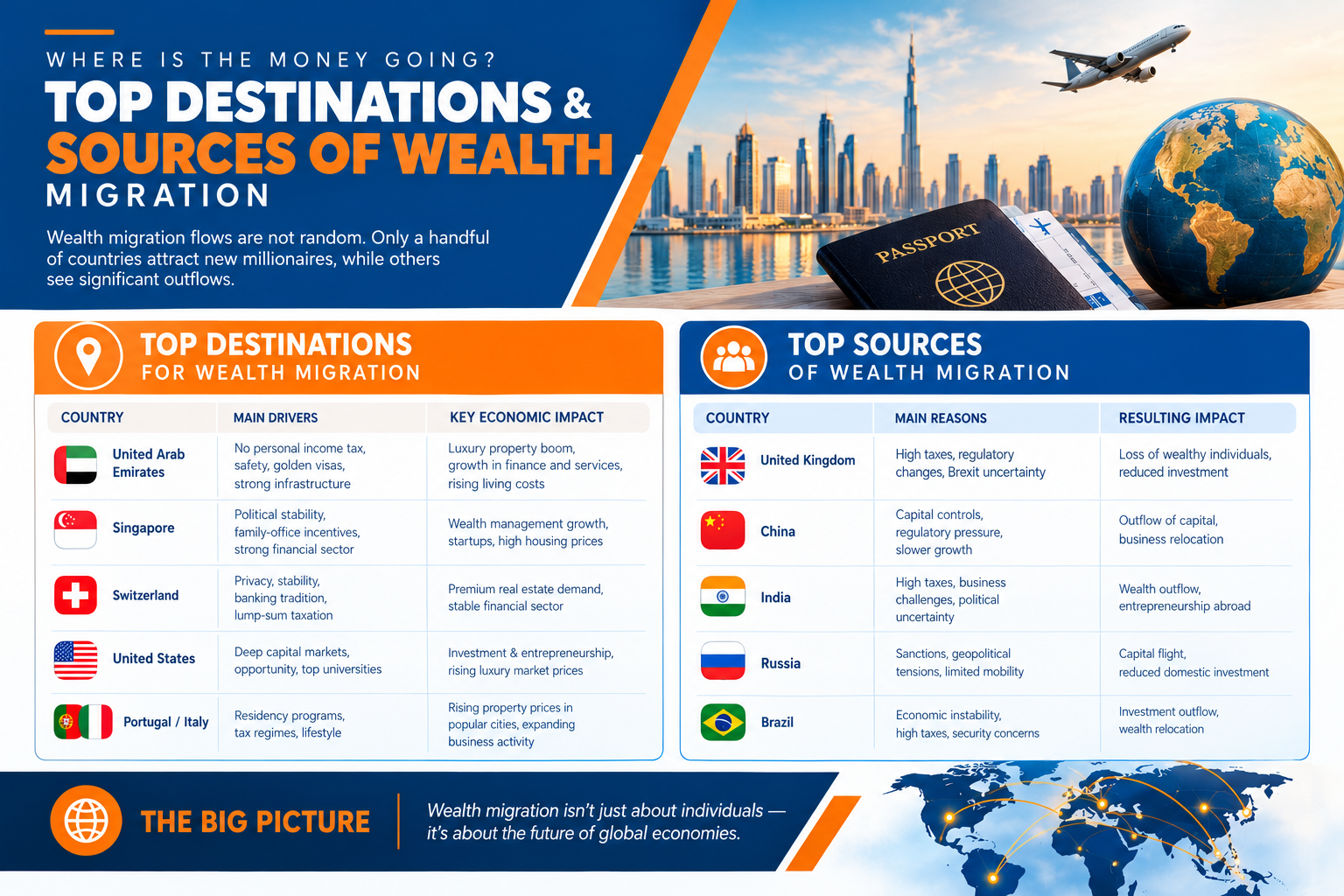
Wealth migration flows are not random at all. Instead, they reveal a clear pattern in which only a handful of countries attract new millionaires, while others experience significant outflows. For example, wealth migration flows highlight destinations such as the United Arab Emirates, Singapore, Switzerland, and the United States, which act as magnets for real estate investment and private capital. Furthermore, these countries often appeal to wealthy individuals because of their business opportunities, financial services, lifestyle options, and investment environments. In contrast, countries facing higher taxes, slower economic growth, or political tensions, such as the United Kingdom, China, and India, have experienced notable net outflows of millionaires. Consequently, these contrasting trends demonstrate how economic conditions, political stability, and investment opportunities can influence where wealthy individuals choose to live and invest. Ultimately, wealth migration flows help explain why some economies attract additional capital and investment, while others risk losing valuable financial resources.
Top Destinations for Wealth Migration vs. Top Sources of Wealth Migration
|
Country |
Flow | Main Drivers | Key Economic Impact |
|
United Arab Emirates |
Inflow | No personal income tax, safety, golden visas, strong infrastructure |
Luxury property boom, growth in finance and services, rising living costs |
|
Singapore |
Inflow | Political stability, family-office incentives, strong financial sector |
Growth in wealth management and startups, high housing prices |
|
Switzerland |
Inflow | Privacy, stability, banking tradition, lump-sum taxation |
Strong demand for premium real estate, a stable financial sector |
|
United States |
Inflow | Deep capital markets, opportunity, top universities |
Major investment and entrepreneurship, rising prices in luxury markets |
|
Portugal / Italy |
Inflow | Residency programs, tax regimes for foreign income, lifestyle |
Rising property prices in popular cities, local affordability concerns |
|
United Kingdom |
Outflow | Tax changes, political uncertainty, cost of living | Reduced tax base, softer demand in top-end property |
| China | Outflow | Economic slowdown, regulatory uncertainty, capital controls |
Capital flight and weaker domestic investment |
|
India |
Outflow | Tax burden, global business opportunities, education for children |
Brain drain and loss of entrepreneurial capital |
Note: Rankings and figures change each year. Always check the latest Henley & Partners Private Wealth Migration Report for current data.
The Economic Impact of Global Wealth Migration
Real estate is usually the first place where the economic impact of global wealth migration becomes visible. When high-net-worth individuals (HNWIs) arrive in large numbers, demand for premium homes often surges. For example, cities like Dubai, Miami, Lisbon, and Singapore have all experienced luxury property booms linked to inflows of wealthy residents and foreign buyers.
Furthermore, the effects extend far beyond the initial increase in luxury property prices. As prices in the high-end market rise, property values across surrounding areas may also increase. Consequently, developers often respond by focusing on high-end developments because they offer greater profit potential. However, this shift can create serious challenges for local residents. As a result, housing becomes less affordable, rent prices may rise sharply, and first-time homebuyers increasingly struggle to enter the market. Over time, established communities may also begin to change as long-term residents are priced out of their neighborhoods.
Meanwhile, the effects of economic impact of global wealth migration can be quite different in the countries these wealthy individuals leave behind. As more affluent homeowners sell their properties and relocate abroad, demand for high-end homes in their original markets may weaken. In turn, this reduced demand can slow activity in certain segments of the property market. Ultimately, global wealth migration can reshape housing markets in both destination countries and countries of origin, creating new investment opportunities while intensifying affordability challenges for local communities.
Impact on Tax Revenue and Public Finances
A few wealthy taxpayers contribute a large share of income tax and capital gains tax. When those wealthy taxpayers leave the country loses not the current revenue but also future inheritance, investment and consumption tax. Governments that lose earners must either cut spending raise taxes on those who remain or borrow more.
Impact on Innovation and Entrepreneurship
Does the migration of wealth bring business or just passive capital? The evidence is mixed. When entrepreneurs move, they often. Grow companies in their new home. This brings jobs. Draws in skilled workers. Places like Singapore and Dubai have worked hard to attract founders and investors. They wanted to build startup ecosystems.. Not all of the incoming wealth gets used this way. Some of it goes into buying property or financial assets. This kind of capital does not help the economy much. It doesn’t create jobs or raise productivity. The real question is whether a country can turn this wealth into investment. That’s what makes the difference, in the run.
Capital Flight and Brain Drain
Wealth doesn’t stay in one place. Capital flight takes money away. It reduces investment in the country. It makes the money of the country weaker. It makes it more expensive to borrow money. At the time when founders, leaders and workers leave it causes brain drain. It takes away skills. It takes away connections. It takes away energy for starting businesses. For countries that are still growing this big loss can slow down progress, for a time. It makes it harder to pay for schools and roads and other important things.
Impact on Economic Inequality
Wealth migration also has an impact on economic inequality both inside countries and between them. In cities that receive newcomers the arrival of high-income individuals can push up housing prices and everyday costs faster than wages rise. This makes life harder for residents who aren’t as well off. Across countries when money moves from unstable economies to richer more stable ones it can make global inequality worse over time. Some people believe that capital should flow where it’s most productive and that competition, among nations can lead to policies. Others say this system allows the rich to dodge their duties and responsibilities something ordinary people don’t have the choice to avoid.
Winners and Losers: A Balanced View
We should not think of wealth migration as good or only bad. Wealth migration brings money, more taxes and fresh business ideas to the places people move to but it can also push up house and stock prices and stir up social problems. At the time the places people leave lose money and skilled people yet that loss can push them to change tax rules fix government work and grow more competitive. The overall effect of wealth migration depends a lot, on the rules and choices made by both the places people move to and the places they leave.
How Investors and Policymakers Can Respond
Understanding how global wealth moves affects the economy is only helpful if it leads to choices. Investors and governments both have options to consider.
- For investors: Watch how wealth moves around the world before putting money into anything. Cities that attract rich people often have high demand for fancy homes, private schools and services but prices can get too high. Spreading investments across real estate markets around the world helps reduce that risk.
- For governments in the countries where wealth is leaving: Being fair with taxes having rules and keeping a good business environment work better than just charging extra taxes when people leave. These steps can slow down people taking their money and skills elsewhere.
- For governments in the countries where wealth is moving to: Offer reasons for rich people to come but also make sure things stay affordable for everyone. This can include building homes charging extra fees on foreign buyers and setting rules that encourage real businesses instead of just buying property.
- For businesses and experts: People who understand the rules of different countries especially when it comes to taxes, laws and following the rules are needed more, than ever. Wealth moving around the world is changing where people live and where their money is kept.
The Future of Wealth Migration
Several trends are likely to influence how people move their wealth over the next ten years. First of all, governments are paying closer attention to programs that offer citizenship in exchange for investment. At the same time, exit taxes and international tax regulations are evolving in an effort to make tax-driven relocation less attractive. However, other developments are making it easier for wealthy individuals to choose where they want to live. For instance, remote work opportunities, specialized visas for digital nomads, and the growing prominence of financial centers in the Middle East and Asia are providing more relocation options.
In addition, geopolitical tensions, climate-related risks, and generational wealth transfers are likely to accelerate these movements. As a result, competition for real estate investment may become increasingly intense, while high-net-worth individuals seek new markets and opportunities. Furthermore, countries will need to balance their efforts to attract foreign capital with the needs of their local populations. Consequently, policymakers will continue debating how to encourage investment while protecting housing affordability and economic fairness. Ultimately, the challenge will be to create policies that welcome investment without deepening inequality or placing excessive pressure on local communities.
Frequently Asked Questions (FAQ’S)
What is global wealth migration?
The cross-border movement of high-net-worth individuals (HNWIs) typically people with investible wealth of $1 million or more along with their families, businesses, and capital
What are the primary economic impacts on destination (host) countries?
Capital Inflow & Spending: Boosts local real estate, luxury markets, private banking, healthcare, education, and professional services.
Multiplier Effect: Incoming family offices and entrepreneurial founders can seed local venture ecosystems, mentor startups, and finance new economic sectors.
Fiscal & Asset Pressures: High-value property acquisitions can elevate local housing and real estate prices, while shifting tax receipts depending on whether they pay flat or zero-income tax.
Why are wealthy individuals moving right now?
Tax Policy Shifts: Elimination or tightening of tax regimes (e.g., the UK’s non-dom rules, European wealth/residency adjustments).
Geopolitical & Personal Security: Rising global fragmentation, conflicts, and political instability.
Sovereignty & Diversification: Seeking multi-jurisdictional residency, “golden visas,” or citizenship-by-investment to hedge against systemic risk.
What are positive effects of migration on society and the economy?
Migration can boost economic growth, fill labor shortages, encourage innovation, increase tax revenues, and enrich cultural diversity. It also supports families through remittances and strengthens international trade, investment, and business connections.
What are reasons for migration?
Economic Opportunity and Poverty: Many people move to find better jobs, higher wages, and a higher standard of living than what is available in their home region.
Conflict, War, and Violence: Armed conflict, civil wars, and general insecurity force millions of people to flee their homes to find safety.
Persecution and Oppression: Individuals and families often escape targeted mistreatment based on their race, ethnicity, religion, political beliefs, gender, or sexual orientation.
What are the challenges of global migration?
Physical and Mental Health Risks: Traumatic journeys, dangerous border crossings, and exposure to violence or exploitation lead to high risks of injury, illness, and psychological distress.
Exploitation and Abuse: Irregular migrants often rely on human traffickers or smugglers, increasing vulnerability to forced labor, detention, and human rights violations.
Precarious Working and Living Conditions: Migrants frequently face labor market discrimination, lack of social protection, and earnings lower than local workers.
What are the three main categories of global migration?
The three main categories of global migration, based on the driving forces behind the movement, are labour (economic) migration, family migration, and humanitarian migration.
What are the current global migration trends?
There are approximately 304 million international migrants globally, making up about 3.7% of the world’s population, according to data from the Migration Policy Institute.