

Florida Condo Reserve Requirements 2026: What the SIRS Mandate Means for Your Association’s Budget
If your community association has been answering owner questions about rising assessments you already know the pressure is real. Florida condo reserve requirements 2026 is a change from the old system that let owners waive or cut reserve funds for decades.
Florida condo reserve requirements 2026 mean that for any building with three or more habitable stories reserves tied to parts cannot be waived or cut by a vote of the members – no exceptions. Boards that planned budgets expecting owners could vote reserves down are now working under a different set of rules. Florida condo reserve requirements 2026 will show up on the maintenance‑fee statement in 2026. That reality will feel very different, from the past.
This post walks through how the state got. It explains what a Structural Integrity Reserve Study (SIRS) actually covers. It shows the dollar threshold that decides which items must be reserved. It also describes the financing tools that boards now have to soften the blow.
The Legislative Timeline: From SB 4-D to HB 913
The current framework did not appear at once. It came about through four legislative sessions. Each of these sessions responded, in one way or another to the 2021 Champlain Towers South collapse in Surfside.
- SB 4-D (2022) created the SIRS requirement. This law applied to buildings three stories or taller. It set the SIRS deadline as December 31 2024. Importantly it made a key rule: structural reserves identified by SIRS cannot be waived by a vote of the owners.
- SB 154 (2023) sometimes called a “glitch bill,” fixed confusion from SB 4-D. It clarified what parts of a building must be included in a SIRS. It allowed reserve contributions to grow with inflation. It gave condominium associations with multiple buildings an alternative way to fund their reserves.
- HB 1021 (2024) known as “Condo 3.0 ” focused more on governance than on reserves. It required board members to get education. It added penalties for bad-faith behavior. It also gave the Division of Florida Condominiums power to investigate problems. This bill confirmed that full funding of SIRS reserves must start in the 2026 budget cycle. And this funding cannot be waived.
- HB 913 (2025) is the law that boards are following today. It took effect on July 1 2025. One major change was pushing the SIRS completion deadline from December 31 2024 to December 31 2025. Associations that are working on a SIRS and a milestone inspection together have an extra time. Even then they can’t go past December 31 2026. That date is the latest, for any building still trying to complete its SIRS.
Each bill is added on top of the one, which is why so many boards are confused about what applies to them right now. The simple version: if your building has three or more habitable stories the -waivable reserve rule, from SB 4-D still applies the deadline is the one set by HB 913 and the dollar threshold and funding flexibility are the ones introduced by HB 913.
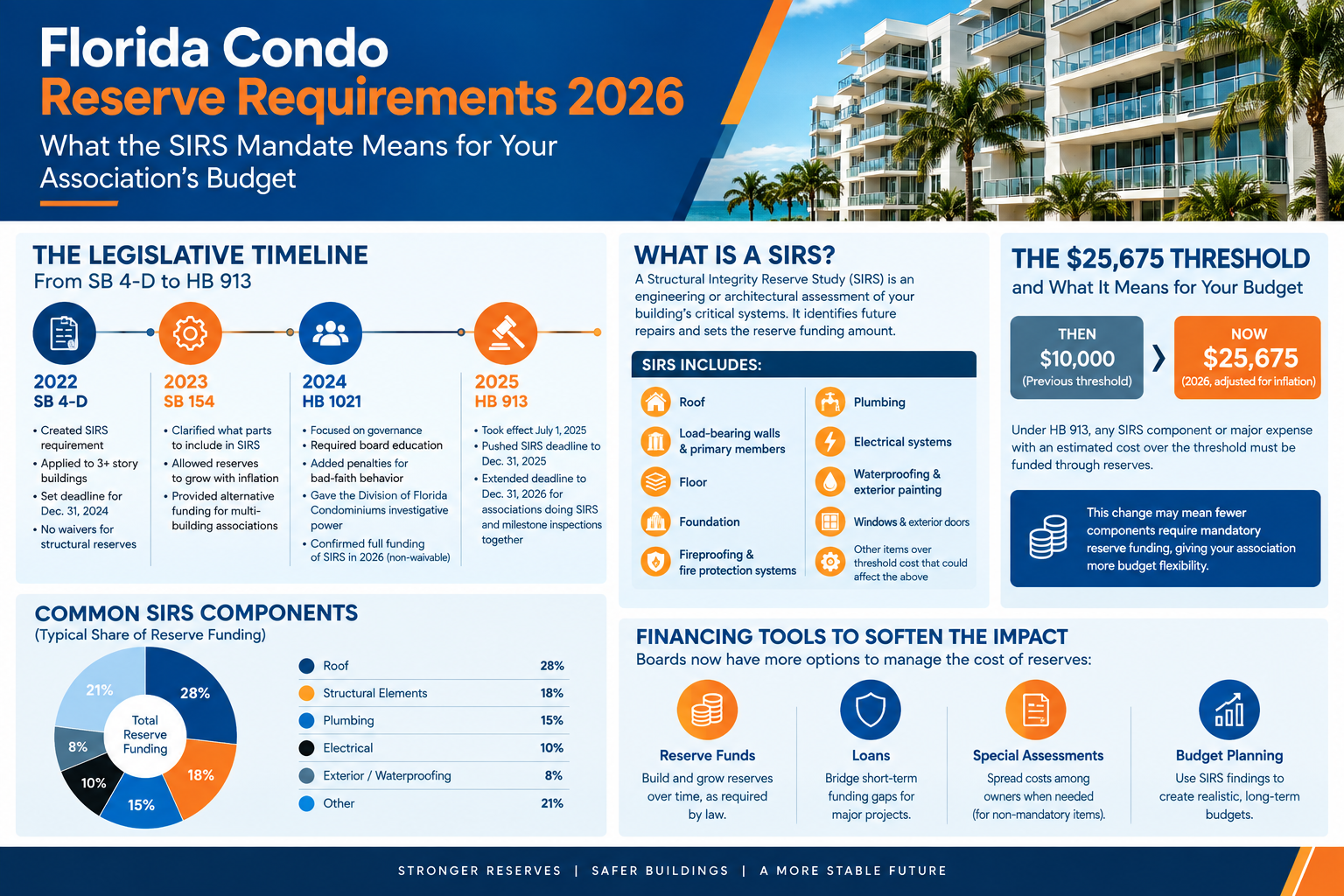
What Is a Structural Integrity Reserve Study (SIRS)?
SIRS is a check done by an engineer or architect. SIRS look at the building systems that’re most likely to endanger structural safety if they are ignored. SIRS is required every ten years for any condominium or building that has three or more habitable floors. SIRS give the basis for how much the association must set aside for future repairs.
- Roof
- Load‑bearing walls and other primary structural members
- Floor
- Foundation
- Fireproofing and fire protection systems
- Plumbing
- Electrical systems
- Waterproofing and exterior painting
- Windows and exterior doors
- Any other item that costs more than the statutory threshold to replace and whose failure would negatively affect any of the categories above
SIRS show that the SIRS list is not fixed. For example, a costly HVAC system tied into fire protection could pull in items, beyond the enumerated eight. Boards should review each SIRS report carefully than assuming only the named categories apply.
The $25,000 Threshold and What It Means for Your Budget
One of the important changes in HB 913 was increasing the minimum cost threshold for mandatory reserve funding. Under the rule any SIRS component or major expense. Like a roof replacement, building painting or pavement resurfacing. With an estimated cost over $10,000 had to be funded through reserves. That threshold was raised to $25,000. Is now adjusted each year for inflation. For the year 2026 the updated amount is $25,675.
In practice this means that smaller expensive items that once required mandatory reserve funding may now fall below the new threshold. That could mean fewer components a board is required to fund.. It’s important to understand that this change does not lower the total amount of money that must be set aside for major structural items. The big-ticket items. Like roofs load-bearing structures and other SIRS categories. Always cost more than $25,675 no matter the size of the building. So those obligations remain unchanged.
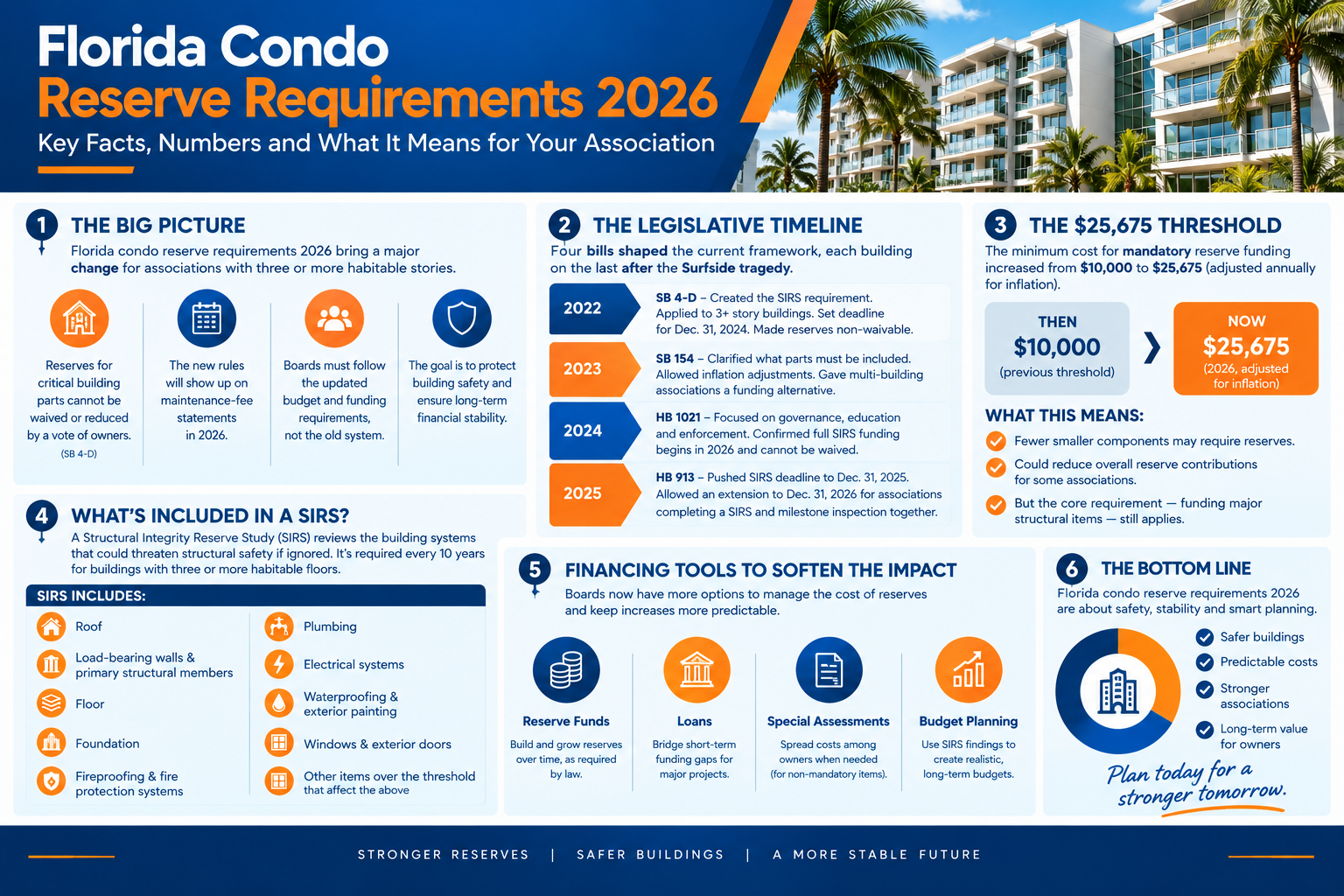
Boards should not assume the higher threshold means they can reduce their reserve funding. This is not a rollback of responsibilities. It’s a re calibration. The core financial obligations tied to building systems are still, in place. The change shifts which items are automatically covered by the mandatory reserve rule.
Non-Waivable vs. Waivable Reserves: What Boards Must Know
This difference confuses boards and lies at the core of the Florida condo reserve rules for 2026 SIRS.
SIRS‑identified structural reserves cannot be waived. When a part shows up on the SIRS list and passes the limit the association must pay for it at the amount the study suggests. Owners cannot vote to waive, cut or postpone that payment. This is very different from before 2022, when a simple majority at an announced meeting could eliminate reserves completely.
Traditional reserves that are not part of SIRS can still be waived. Things such as pool resurfacing, clubhouse renovation, tennis court repaving or other amenity projects are not, on the SIRS list. They can still be. Lowered by a majority vote of those who attend a properly announced membership meeting according to § 718.112(2)(f) of Florida Statutes. Boards updating their budget resolution should make this split clear for owners. A single line item called “reserves” can cause confusion when part of that amount cannot be changed by law and part can.
SIRS Reserve Components and Funding Status
| SIRS Component | Funding Status | Waivable by Member Vote? |
Statutory Threshold |
|
Roof |
Mandatory | No |
> $25,675 |
|
Load-Bearing Walls / Primary Structural Members |
Mandatory | No | > $25,675 |
|
Floor |
Mandatory | No |
> $25,675 |
|
Foundation |
Mandatory | No |
> $25,675 |
|
Fireproofing & Fire Protection Systems |
Mandatory | No | > $25,675 |
|
Plumbing |
Mandatory | No | > $25,675 |
| Electrical Systems | Mandatory | No |
> $25,675 |
|
Waterproofing & Exterior Painting |
Mandatory | No |
> $25,675 |
|
Windows & Exterior Doors |
Mandatory | No |
> $25,675 |
|
Other items affecting the above (over threshold) |
Mandatory | No |
> $25,675 |
|
Non-SIRS Reserves (pool, clubhouse, etc.) |
Optional | Yes (majority vote) |
N/A |
Fannie Mae’s 15% Reserve Threshold (Effective January 4, 2027)
State law isn’t the thing putting pressure on association budgets. Fannie Mae and Freddie Mac are increasing the minimum reserve funding standard for condo financing. Starting January 4 2027, the required reserve level will go from 10% to 15% of assessment income for loan applications on or after that date. There is one exception: the 15% requirement does not apply if the association has a reserve study that was conducted or updated within the three years and is funding at the highest recommended level. The old way funding no longer counts as a valid alternative.
Associations that are already following Sound Reserve Funding Standards (SIRS) might be closer, to compliance than they realize. Boards should not wait until late 2026 to check their numbers. It’s better to model the required funding A building that falls short of the 15% threshold risks losing conforming loan eligibility. That can slow down sales. Refinancing long before the January 2027 date even arrives. Lenders are already adjusting their underwriting practices in advance so the impact could show up sooner than expected.
Funding Options: Special Assessments, Loans, and Lines of Credit
HB 913 gave boards tools to meet obligations without one big special assessment. Associations can fund SIRS reserves by assessments by a special assessment by a line of credit or by a loan. Using an assessment, a line of credit or a loan for this purpose requires approval by a majority of total voting interests not only those who are at a meeting. This requirement is stricter than the vote needed to waive non‑SIRS reserves.
When associations have a gap between current reserves and the funding recommended by SIRS spreading the cost over a financing instrument can stop the five‑figure special assessment notices that were in the news after the original 2024 deadline. Boards should weigh the cost of financing, against the relief to cash flow carefully. Boards should also tell owners the trade‑offs before the vote.
The Two-Year Pause Option (HB 913)
Many associations find themselves trying to fix the problems that a milestone inspection points out while also chasing SIRS funding. HB 913 gives these associations a breathing room. If a budget is approved on or before December 31 2028. The association completed a milestone inspection in the last two years the association can with a majority vote of all voting interests, pause or lower reserve contributions for, up to two consecutive budgets. This lets the association put money toward the repairs that the milestone inspection highlighted. The rule says that if the association takes this pause it must finish a SIRS before it starts making reserve contributions. That way the association can figure out the funding needs and set a reserve plan that follows the rules. The purpose of this option is to organize spending so that the association fixes what the milestone inspection flagged first than to keep the SIRS requirement on hold forever.
FAQ’s
Which buildings need a Structural Integrity Reserve Study (SIRS)?
Required for residential condominium and cooperative buildings that are 3 or more habitable stories tall.
What are the deadlines for SIRS completion?
Existing unit-owner-controlled associations had to complete their initial SIRS by December 31, 2025.
The outer deadline of December 31, 2026 applies specifically to associations completing the SIRS combined with a milestone inspection due by that date.
Can condo associations still waive or reduce reserve funding?
No for structural components covered under the SIRS (such as roofs, load-bearing walls, fireproofing, waterproofing, and structural integrity items). These must be fully funded.
Traditional or non-structural optional reserves may still face a membership waiver or reduction vote depending on the association’s bylaws
How do federal lenders (Fannie Mae / FHA) impact Florida reserves in 2026?
FHA requires HOAs to allocate at least 10% of total monthly assessments into reserves.
Fannie Mae maintains a minimum replacement reserve requirement moving toward a 15% benchmark under updated guidelines. Projects failing to meet these thresholds face financing restrictions.
Where can official guidance and compliance tools be found?
Associations and buyers can check state resources via the DBPR Condominium Information & Resources and review transaction guidelines through platforms like Florida Condo Reserve Study: What It Means for Buyers.
What happens if an association fails to fund non-waivable reserves?
Personal Liability: Board members can face personal breach of fiduciary duty lawsuits for failing to comply with statutory funding mandates.
State Penalties: Regulatory agencies (such as Florida’s DBPR) can issue severe financial fines and administrative penalties against the association.
Loss of Insurance: Insurance carriers may refuse to renew property and casualty or Directors and Officers (D&O) policies for non-compliant buildings.
Can an association use non-waivable reserve funds for alternative projects?
Strict Segregation: No. Non-waivable structural reserves cannot be co-mingled, borrowed from, or used for any purpose other than their designated structural component.
Contrast with Waivable: Traditional waivable reserves (like painting or pool resurfacing) can sometimes be reallocated to other projects if the membership votes to approve the transfer. Non-waivable reserves completely eliminate this voting option.
How do these reserve types impact buyers trying to get a mortgage?
Lender Rejections: Conventional lenders (following Fannie Mae and Freddie Mac guidelines) strictly require associations to allocate at least 10% of their annual budget to reserves.
Lending Bans: If an association routinely waives its flexible reserves or fails its non-waivable structural reserve milestones, the entire building may be flagged as “warrantable” or blacklisted, preventing buyers from getting mortgages.
Conclusion
The Florida condo reserve requirements for 2026 SIRS mandate will continue to change as inflation adjustments Fannie MAs phase-in and upcoming legislative sessions introduce complications. At this time boards and owners should:
- Verify your SIRS status. Make sure your study was finished by the required deadline and that the board has signed the acknowledgment affidavit.
- Update governing documents and budget language to show the $25,675 threshold and to clearly separate -waivable SIRS reserves from waivable non-SIRS reserves.
- Model the Fannie Mae 15 percent requirement even though the requirement will not take effect until January 4 2027. Lenders are already including it in underwriting.
- Communicate funding options clearly. Whether the board is thinking about an assessment, a loan or the two-year pause owners deserve to see the numbers and trade-offs before any vote.
This article is for informational purposes only and does not constitutes legal advice. Association specific questions, about SIRS compliance, reserve funding or financing options should be addressed to Florida licensed community association counsel.